
$79K in Premium YTD — What Covered Calls Actually Look Like in Practice

Most traders say covered calls don’t work.
But if you press a little deeper, what they usually mean is:
They didn’t stay consistent long enough to see them work.
The Reality Most People Don’t See
There’s a big gap between how covered calls are talked about and how they’re actually executed in a structured environment.
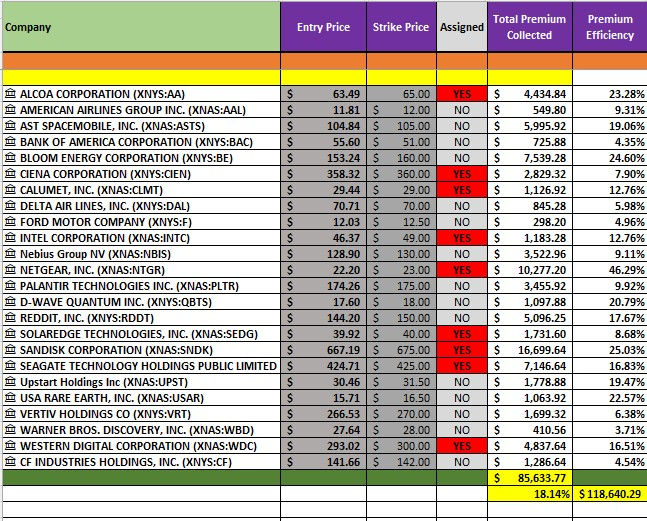
This year, several accounts have been managed using a disciplined covered call framework.
One of those accounts, roughly $500K in size, offers a clean example of what this strategy actually looks like when applied consistently.
Year-to-Date Snapshot
Premium Collected: ~$79,000
Premium Yield: ~15.8%
Total P&L: ~$84,000
Total Return: ~16.8%
That spread between premium income and total P&L is where the real story lives.
The One Line That Changes Everything
Premium is what you control.
Equity movement is what you manage.
Most traders flip this.
They obsess over price direction and treat premium like a bonus.
The CCR approach does the opposite.
Premium becomes the primary driver, and stock movement becomes a variable you manage—not predict.
How the Strategy Is Actually Run
This isn’t random call selling. It’s structured.
1. Timeframe: ~30 Days to Expiration
Consistent cycle length
Predictable premium behavior
Repeatable decision-making
No guessing short-term direction. No stretching timelines.
Just the same window, over and over.
2. Position Structure: 10–12 Holdings
Diversified exposure
Reduces single-name risk
Smooths income across the cycle
This matters more than most people realize.
One trade doesn’t define the outcome. The portfolio does.
3. Premium Profile
Most trades generate 3–5% per cycle
Higher volatility setups reach ~10–13%
Not every trade is a home run.
And that’s the point.
Consistency > spikes.
4. Assignment Is Expected (~55%)
Let’s be clear:
Assignment is not a mistake. It’s one of the outcomes.
In this structure:
~55% of positions get called away
~45% expire worthless
Both are valid outcomes.
This is where most traders break the system—by trying to avoid assignment at all costs.
5. No Rolling
This is where things get controversial.
There is no rolling in this approach.
If shares get called:
→ They get called.
Why?
Because rolling often turns a structured system into emotional decision-making.
Instead, the process resets cleanly each cycle.
6. Strict Entry Rules (No Chasing)
Every position comes from a predefined scan:
Liquidity filters
Premium thresholds
Delta positioning
Structured selection from the CCR weekly list
No mid-cycle chasing.
No “this looks good today” entries.
Discipline is the edge.
What Most Traders Get Wrong
They think the strategy is about:
Picking the right stock
Timing the market
Avoiding assignment
Maximizing one trade
It’s not.
It’s about running the same structure repeatedly.
The Real Edge: Repetition
This is not a “great trade” strategy.
It’s a repeatable system.
Same:
Time horizon
Selection criteria
Position sizing
Decision process
Every cycle.
The moment you start adjusting based on the last outcome:
You chase winners
You avoid losses emotionally
You break the math
And results get messy fast.
The Hidden Truth About Covered Calls
Covered calls don’t fail because the strategy is broken.
They fail because the execution is inconsistent.
Changing DTE every trade
Rolling impulsively
Overreacting to assignment
Chasing premium spikes
Ignoring structure
That’s not a strategy.
That’s improvisation.
What This Actually Shows
This example isn’t about showing “what’s possible.”
It’s about showing what consistency looks like.
Premium shows up regularly
Stock movement adds variability
Outcomes balance over time
No prediction required.
Just structure and discipline.
Final Thought
This approach won’t appeal to everyone.
It’s not flashy.
It doesn’t rely on big directional bets.
It doesn’t try to outsmart the market.
But it does something most strategies don’t:
It standardizes decision-making.
And over time, that’s where the real edge comes from.
If You Want the Framework
If you’re trying to understand how this is structured:
How stocks are selected
How strikes are chosen
How premium thresholds are defined
How positions are sized each cycle
That’s exactly what the CCR model is built around.
Try the service to get the full weekly list, structured setups, and real trade examples.
Disclaimer:
This is for informational and educational purposes only and does not constitute financial advice. Options involve risk and are not suitable for all investors. Always do your own research or consult with a licensed financial professional.


Comments