
The Covered Call Playbook: Building Income Without the Guesswork

There’s a version of covered call trading that looks like this: scan for the biggest premium, sell it, hope for the best, repeat.
And there’s a version that actually works.
The difference isn’t access to better data or a faster platform. It’s having a clear framework for what makes a setup worth taking — and the discipline to ignore everything that doesn’t fit.
-----
## Start With What You’re Actually Measuring
Before anything else, get the ROI calculation right — and keep it honest.
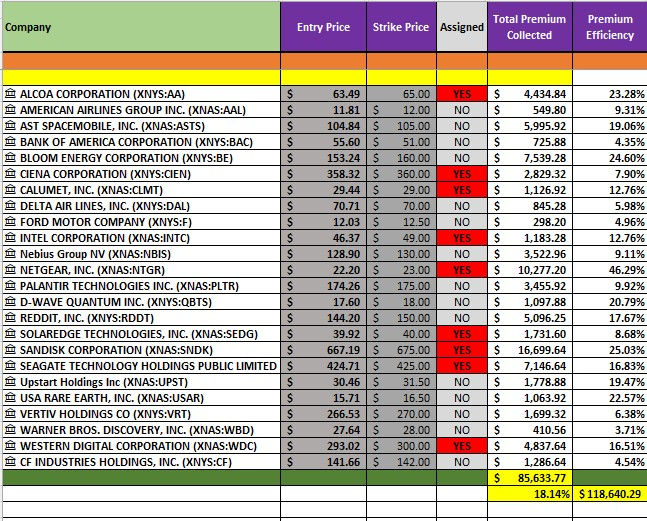
Divide the premium you collected by what you paid for the shares. That’s your cycle return. A $180 premium on a $9,000 cost basis is 2% for the period. Clean, simple, real.
Where traders get tripped up is layering in projections — annualized figures, theoretical appreciation, best-case scenarios. Those numbers aren’t wrong to track, but they shouldn’t be what drives your decision to enter. The only return you can count is the one sitting in your account when the cycle closes.
If the stock rises to your strike and gets called away, that capital gain on top of your premium is a welcome outcome. Build the trade assuming you won’t get it.
-----
## Reading What the Premium Is Actually Telling You
Premium doesn’t appear out of thin air. It reflects what the market believes a stock is capable of doing before expiration.
Elevated premium almost always means one of a few things: the stock has been moving sharply, there’s an event on the horizon (earnings, an FDA decision, a product announcement), or the broader market is in a period of heightened uncertainty. In any of those cases, the market is effectively paying you more to take on more.
This is where covered call trading requires genuine judgment, not just math. A rich premium on a volatile stock might be entirely worth taking. It might also be the market’s way of warning you that the ground is unstable. The question every trader needs to answer before entering: does the income justify what could happen to the underlying?
If you can’t answer that clearly, the trade isn’t ready.
-----
## The Case for a Consistent Expiration Window
One of the most underrated decisions in covered call trading is how far out you sell.
Very short expirations — weekly or less — generate impressive annualized numbers that can obscure how much active management they actually require. You’re constantly making decisions, re-entering positions, and eating transaction costs. For most income-focused traders, that’s not efficiency. It’s busyness disguised as productivity.
On the other end, longer-dated options park your position for an extended stretch and limit your ability to respond to changing conditions.
The roughly 30-day range works because it balances two things at once: enough premium to make the cycle meaningful, and a tight enough window that your capital isn’t locked up waiting for a trade to resolve. Theta — the daily decay that benefits the option seller — also becomes more consistent and predictable in this window. That consistency is what allows covered call income to become systematic rather than situational.
-----
## Choosing Your Strike With Intention
Strike selection is where most of the real decision-making happens — and where the most common mistakes get made.
Delta offers a useful lens here. It’s a rough approximation of the probability your call expires in the money, which means your shares get called away. A 0.25 delta call has roughly a 25% chance of assignment. A 0.50 delta call is close to a coin flip.
Neither is inherently better. What matters is whether the strike you choose reflects the outcome you actually want.
If you’re committed to a stock long-term and share retention is the priority, a lower delta gives you better odds of keeping your position while still collecting income. If you’re comfortable rotating out of a stock — or even looking for a structured way to exit — a higher delta makes sense, and the premium will reflect it.
The version of strike selection that consistently underperforms is picking a number because it feels safe, or because the annualized return looks impressive, without thinking through what happens in both scenarios: assignment and no assignment. Walk through both before you enter.
-----
## Getting Comfortable With How This Ends
Covered calls have two possible outcomes at expiration. One is that the option expires worthless, you keep the premium, and you still own the shares. The other is that the stock closes above your strike, the shares get called away, and you keep the premium plus whatever gain existed up to that strike.
Both of those are wins.
Where traders create unnecessary frustration is treating assignment as an unwanted result — something that happened *to* them. That framing turns a working trade into a psychological problem. If your shares get called away at a strike you selected, with a premium you collected, you executed the trade correctly. The fact that the stock may have kept running past your strike is beside the point.
Before entering any covered call position, settle the question in advance: are you genuinely comfortable selling these shares at this price? If the answer is no, move the strike or don’t make the trade.
One mechanics note worth knowing: American-style options carry the possibility of early assignment before expiration. It’s uncommon, but it happens — particularly with deep in-the-money calls as an ex-dividend date approaches. It’s not a reason to avoid the strategy, but it’s worth understanding before it catches you off guard.
-----
## When You Enter Matters Too
The timing of your entry has a real impact on the premium you capture — more than most traders account for.
The first stretch of the trading day tends to be the noisiest. Spreads are wider, pricing is less stable, and implied volatility readings are often inflated by overnight uncertainty that hasn’t resolved yet. Entering a covered call in the opening minutes because the premium looks good in pre-market is a reliable way to leave money on the table or get a sloppy fill.
Mid-morning, after the initial volatility settles, typically offers a better combination of stable pricing and reasonable IV levels. You’re not chasing a number that may already be deflating.
Also worth knowing: implied volatility tends to build in the days leading up to earnings and then drop sharply the moment the announcement is made — regardless of whether the results were good or bad. Carrying a short call through an earnings event is a decision, not a default. Make it intentionally.
-----
## Running This as a Repeatable Process
Covered call trading rewards structure more than intuition. The traders who do this well over time aren’t necessarily smarter about individual setups — they’re more consistent about how they evaluate every setup the same way.
That means defining your parameters before you start screening, not after. What ROI range are you targeting? What’s your acceptable delta range? Are there sectors or event-driven names you’re avoiding this cycle? Having those answers in advance keeps you from rationalizing a trade that doesn’t fit because the premium looked interesting.
It also means sizing positions with the portfolio in mind, not just the individual trade. No single covered call position should carry enough weight to create a real problem if it goes sideways. The income this strategy generates is meaningful precisely because it compounds over many cycles — not because any single cycle produces an outsized result.
Finally, keep a record. Not as a formality, but as a feedback mechanism. Over time, your own trade history will tell you more about where your process is strong and where it’s leaking than any external resource will.
-----
## What This Strategy Is — and Isn’t
Covered calls aren’t a tool for capturing explosive upside. By design, they trade away some of that potential in exchange for consistent, defined income.
What they do offer — when run with discipline — is a structured way to generate returns from positions you already hold, create defined exit points, and build income that doesn’t depend on predicting market direction.
Some cycles the shares stay. Some cycles they go. Either way, the premium was collected. That’s the trade.
-----
*Covered Call Research delivers a rules-based framework for evaluating options income opportunities. We do not manage capital or execute trades on behalf of subscribers. Options trading carries real risk and is not appropriate for all investors. This content exists for educational and informational purposes only. Consult a licensed financial professional and conduct your own research before making any investment decisions.*
Educational Disclaimer
This content is provided for informational and educational purposes only and does not constitute financial, investment, or trading advice. Covered Call Research does not manage money or place trades on your behalf. All examples are for illustrative purposes only and do not reflect actual performance.
Options trading involves risk and is not suitable for all investors. Strategies such as covered calls carry potential risks, including assignment, market loss, and opportunity cost. You are solely responsible for your own investment decisions.
Always conduct your own research and consider consulting with a licensed financial professional before engaging in any trading activity.


Comments