
What Happens After You Sell the Call: The Reality of the 30-Day Covered Call Cycle

Most people think the trade ends the moment they sell the call.
That’s the biggest misunderstanding in covered calls.
Because the truth is —
that’s where the strategy actually begins.
When you enter a covered call, you’re not placing a one-time trade.
You’re stepping into a 30-day cycle — and what happens inside that cycle determines your outcome.
Not the entry.
Not the stock pick.
The management and structure.
The Real Edge Isn’t Entry — It’s the Lifecycle
Beginner content focuses heavily on how to enter a covered call.
But experienced traders understand something different:
The entry is just the starting point.
The edge comes from how the position evolves over time.
Covered calls are not about predicting direction.
They’re about positioning yourself to get paid across multiple outcomes.
To understand that, you have to look at the full cycle.
Week 1: The “Nothing Is Happening” Phase
Right after entering the trade, most people expect immediate movement.
That doesn’t happen.
During the first few days:
Time decay (theta) is still slow
Option value barely changes
The position feels stagnant
This is where newer traders start second-guessing the trade.
But this phase is completely normal.
You’re not here for day-one movement.
You’re here for time to work in your favor.
Week 2: Theta Starts Doing the Heavy Lifting
Around the second week, things begin to shift.
This is where:
Time decay accelerates
Option premium begins to erode faster
Your position improves — even if the stock doesn’t move much
This is the quiet advantage of covered calls.
You don’t need a big move.
You don’t need to be right on direction.
You just need:
Time
Structure
Discipline
This is where the strategy starts to feel real.
Week 3: Decision Zone — Three Possible Outcomes
By week three, your position typically falls into one of three scenarios:
1. Stock Below Strike (Out of the Money)
Option is losing value rapidly
Assignment risk is low
You’re on track to keep the full premium
This is the cleanest outcome.
2. Stock Near Strike (At the Money)
Assignment probability increases
Small moves matter more
You’re in a “watch zone”
This is where emotions start creeping in.
3. Stock Above Strike (In the Money)
Assignment becomes likely
You’ve captured most of the premium already
Shares may be called away
And this is where most people panic.
The Biggest Mistake: Fighting Assignment
When the stock moves above the strike, a lot of traders:
Try to roll too early
Over-adjust the trade
Turn a structured system into reactive decisions
Let’s be clear:
Assignment is not failure.
It’s part of the design.
You entered the trade knowing:
Your max upside
Your premium collected
Your exit point
If shares get called away, you:
Keep the premium
Capture stock appreciation up to the strike
That’s a successful cycle.
Expiration: The Cycle Completes
At expiration, one of two things happens:
Shares are not called → You keep shares + premium
Shares are called → You keep premium + realized gain
Either way, you generated income.
Then the cycle resets.
The Real Strategy: Repeatable Income, Not Prediction
This is where most people miss the point.
Covered calls are not about:
Picking the perfect stock
Timing the market
Chasing big moves
They’re about:
Running a repeatable structure
Operating in defined 30-day cycles
Accepting different outcomes as part of the system
Letting probability and time do the work
Some cycles:
You keep the shares
Other cycles:
You get assigned
But every cycle:
You collect premium
That’s the consistency.
Why This Matters
Most people look at covered calls as a trade.
That’s the wrong lens.
This is a process-driven income strategy.
The edge doesn’t come from being right once.
It comes from executing the same structure:
Over multiple positions
Over multiple cycles
Without breaking discipline
That’s how you turn it into something real.
Final Thought
If you judge covered calls based on one trade,
you’ll miss the entire point.
If you run them as a system,
you start to see what they actually are:
A structured way to generate income
regardless of short-term market direction.
Same structure.
Same timeframe.
Every cycle.
Want to See This in Practice?
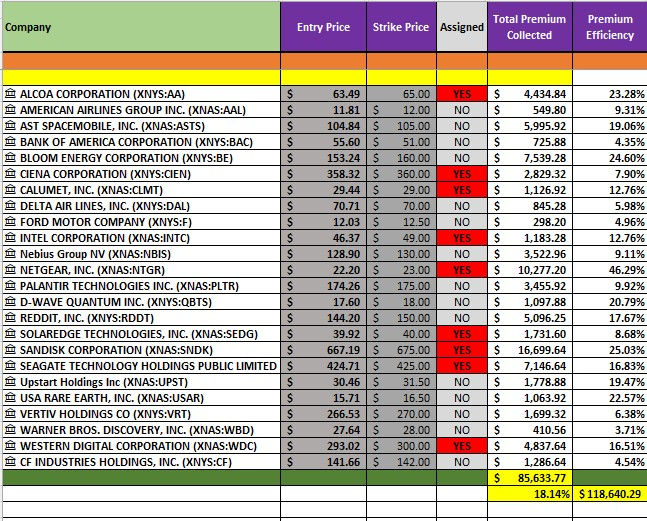
Each week, I track and structure covered call setups using this exact approach — focused on premium, probability, and repeatable outcomes.
👉 Visit CoveredCallResearch.com to learn more.


Comments